


Description
Wedgwood Josiah Wedgwood Bicentenary 1995 Blue Jasperware Pin Tray
This Wedgwood Josiah Wedgwood Bicentenary Pin Tray commemorates the 200th anniversary of the death of Josiah Wedgwood (1730–1795), the pioneering English potter whose technical innovations and artistic vision transformed the ceramic industry.
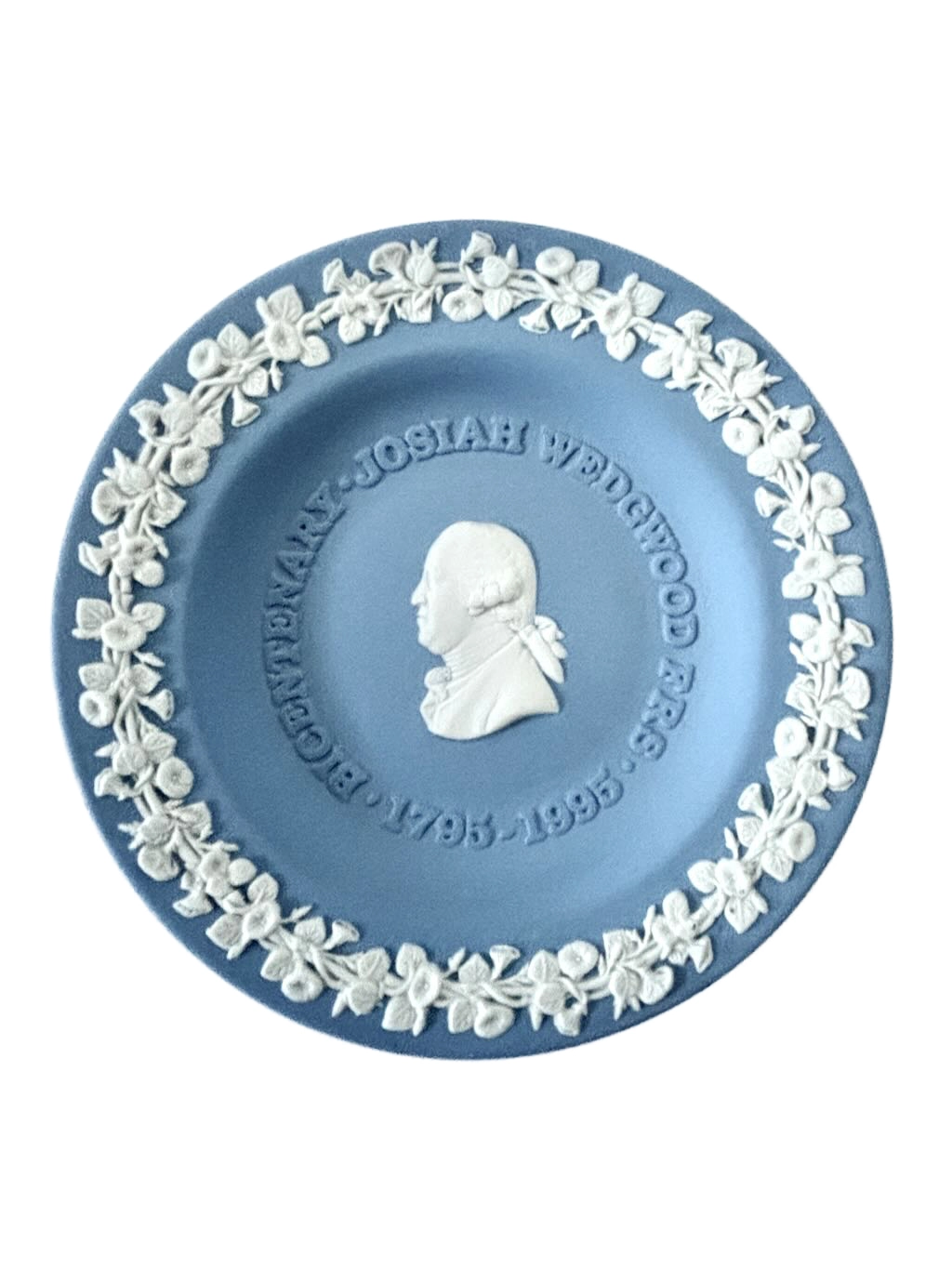
Produced in 1995, the small commemorative dish features a finely modeled white profile portrait of Josiah Wedgwood against the company’s celebrated pale blue Jasperware ground. A circular inscription identifies the founder and commemorative occasion, while an elaborate white floral garland encircles the rim.
Measuring approximately 4 3/8 inches in diameter, this collectible piece celebrates both the remarkable achievements of Josiah Wedgwood and the enduring artistic tradition of the company he established in 1759.
Josiah Wedgwood: A Pioneer of English Ceramics
Josiah Wedgwood was born in Burslem, Staffordshire, in 1730, into a family with longstanding connections to the pottery industry. Through determination, experimentation and an extraordinary understanding of manufacturing and design, he became one of the most influential figures in the history of English ceramics.
In 1759, Wedgwood established his own pottery business, beginning a remarkable career that would transform both the production and marketing of decorative ceramics.
He developed new ceramic bodies, improved manufacturing techniques and introduced innovative approaches to quality control. His achievements helped elevate Staffordshire pottery from a regional industry into an internationally recognized center of ceramic excellence.
Wedgwood also understood the importance of design and artistic collaboration. He worked with leading artists and modelers to create decorative objects that appealed to the growing European enthusiasm for classical antiquity.
His products attracted aristocratic patrons and royal customers, while his innovative business practices helped make finely designed ceramics accessible to a wider audience.
Josiah Wedgwood and the Royal Society
The central portrait identifies Josiah Wedgwood as FRS, an abbreviation for Fellow of the Royal Society.
Wedgwood received this distinction in 1783, reflecting his contributions to scientific investigation and technical innovation. His work extended beyond decorative pottery into the scientific study of materials and the measurement of extremely high temperatures.
One of his important inventions was the Wedgwood pyrometer, a device designed to estimate the intense temperatures encountered in pottery kilns and other industrial processes.
The instrument demonstrated Wedgwood’s interest in applying scientific principles to manufacturing. His experimental approach contributed to improvements in ceramic production and established his reputation as both an industrial innovator and a scientific investigator.
The inclusion of FRS in the commemorative inscription recognizes this important aspect of his legacy.
The Wedgwood Bicentenary of 1995
Josiah Wedgwood died on January 3, 1795, leaving behind a thriving ceramic enterprise and a legacy of artistic and industrial innovation.
Two centuries later, in 1995, Wedgwood commemorated the bicentenary of his death with specially marked decorative objects celebrating the company’s founder.
This blue Jasperware pin tray belongs to that commemorative tradition. Its central portrait and surrounding inscription identify the historical occasion, while the reverse carries the bicentenary dates 1795–1995.
Unlike ordinary vintage Jasperware pieces, which may require examination of manufacturing marks to establish an approximate production period, this commemorative dish provides a clear date associated with its manufacture.
The anniversary also offered an opportunity to recognize the remarkable continuity of the Wedgwood name, which had remained closely associated with English ceramic craftsmanship for more than two centuries.
The Portrait of Josiah Wedgwood
At the center of the dish, a white applied relief depicts Josiah Wedgwood in profile, wearing eighteenth-century dress.
His carefully modeled features, powdered hairstyle and formal clothing reflect the portrait conventions of his lifetime. The composition resembles a classical cameo, an artistic form particularly appropriate for Wedgwood Jasperware.
The portrait is surrounded by a circular commemorative inscription molded directly into the blue ceramic ground. This arrangement creates a restrained and dignified tribute to the company’s founder.
The use of a cameo portrait is especially fitting because Wedgwood helped popularize classical relief decoration during the eighteenth century. The commemorative design therefore celebrates his achievements through one of the decorative techniques most closely associated with his name.
Wedgwood Blue Jasperware
Wedgwood introduced Jasperware during the 1770s after extensive experimentation with ceramic materials and manufacturing techniques.
The distinctive unglazed stoneware provided an exceptionally effective background for delicate applied relief decoration. Its matte surface and contrasting colors allowed Wedgwood to reproduce the appearance of ancient carved cameos and classical sculptural ornament.
Although Jasperware appeared in several colors, the company’s characteristic pale blue became its most recognizable expression.
On this commemorative pin tray, the traditional blue ground provides a beautiful contrast to the white portrait cameo and surrounding floral decoration.
The restrained combination of blue and white connects this twentieth-century commemorative piece directly with the neoclassical aesthetic that Josiah Wedgwood helped establish more than two centuries earlier.
Morning Glory Floral Garland Border
An elaborate white floral garland encircles the outer rim of the dish. The continuous relief features delicate morning glory blossoms, heart-shaped leaves, curling tendrils and intertwining stems, forming a graceful botanical wreath around the commemorative portrait of Josiah Wedgwood.
The morning glory motif is particularly attractive, with its characteristic trumpet-shaped flowers and flowing vines creating a sense of movement and natural elegance. The carefully arranged blossoms and foliage complement the restrained neoclassical character of the central portrait.
Floral garlands have a long history in classical decorative art, where they frequently symbolize beauty, celebration and remembrance. Their use on this commemorative dish provides a fitting ornamental tribute to Wedgwood’s founder.
The crisp white relief contrasts beautifully with the pale blue Jasperware ground, emphasizing the delicate modeling of the flowers and foliage. The result is a harmonious composition that combines botanical ornament with the refined sculptural tradition of Wedgwood ceramics.
The 1795–1995 Bicentenary Backstamp
The underside carries a distinctive commemorative backstamp reading:
WEDGWOOD®
BICENTENARY
1795–1995
MADE IN ENGLAND
This marking distinguishes the dish from ordinary Wedgwood Jasperware production and identifies its connection with the bicentenary commemorations.
The presence of the anniversary dates is particularly useful to collectors because it establishes the commemorative year without relying on approximate dating methods.
Additional small impressed manufacturing marks appear on the underside.
Condition and Collectible Appeal
This Wedgwood Josiah Wedgwood Bicentenary Pin Tray remains in good vintage condition. The blue Jasperware ground retains its characteristic matte appearance, while the white portrait cameo and floral garland present attractively.
Minor signs of age and handling are visible, particularly on the underside, including dark marks and surface scuffs. These are consistent with the item’s vintage condition and should be considered when reviewing the photographs.
The dish offers several features of interest to Wedgwood collectors: a documented commemorative occasion, a portrait of the company’s founder, a distinctive bicentenary backstamp and the traditional blue-and-white Jasperware decoration.
Its compact size makes it suitable for display in a cabinet, on a shelf or alongside other Wedgwood commemorative pieces.
Beyond its decorative appeal, this small dish celebrates the legacy of a remarkable eighteenth-century entrepreneur whose achievements helped shape the history of English ceramics.